Enterprise AI Bottlenecks Stem From Workload Misalignment, Says Info-Tech Research Group
PR Newswire
ARLINGTON, Va., Oct. 5, 2026
Infrastructure challenges often prevent organizations from realizing the full business value of their AI investments, according to recent insights from Info-Tech Research Group. To address this problem, Info-Tech has released its new blueprint, Define Your Target AI Infrastructure. The practical framework is designed to improve AI performance and scalability by helping infrastructure and operations leaders make more informed architecture and sourcing decisions through a workload-driven approach.
ARLINGTON, Va., Oct. 5, 2026 /PRNewswire/ -- As AI adoption continues to expand, enterprises can experience AI performance issues such as slow model training or reduced throughput, which can lead to increased IT costs. Organizations often approach this challenge by acquiring additional compute resources. However, new insights from Info-Tech Research Group indicate that greater long-term value depends on maximizing infrastructure utilization and aligning architecture decisions with workload requirements.
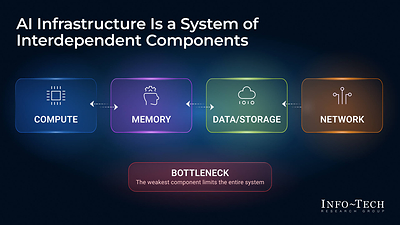
To help infrastructure and operations (I&O) leaders design AI infrastructure that supports performance, scalability, and cost control, the global research and advisory firm has published its new blueprint, Define Your Target AI Infrastructure. The practical framework enables organizations to build balanced AI environments that support long-term performance while managing cost and operational risk.
Info-Tech's analysis highlights that AI infrastructure is an interconnected system in which compute, memory, storage, networking, and physical infrastructure must work together to deliver sustainable performance. For enterprises, this means moving beyond hardware-centric decision-making and selecting architectures and deployment models that optimize utilization, improve scalability, and align technology investments with business objectives.
"Successful AI infrastructure strategies begin with understanding the workload, not the technology," says John Donovan, principal research director at Info-Tech Research Group. "Organizations that treat AI infrastructure as a balanced systems design challenge rather than a hardware acquisition exercise are better positioned to improve utilization, reduce operational risk, and maximize the business value of their AI investments."
Info-Tech's research reveals that workloads shape architecture. Training, inference, retrieval-augmented generation (RAG), agentic AI, and edge AI workloads place distinct demands on compute, memory, storage, and networking. This requires architecture decisions tailored to workload requirements instead of a single standardized technology approach.
According to Info-Tech's blueprint, capacity planning assumptions often fail because AI workloads are highly variable and nonlinear. In addition, AI workloads fundamentally shift network traffic patterns. Traditional enterprise traffic is primarily user-facing (north-south), requiring moderate bandwidth and greater latency tolerance. In contrast, AI traffic is often compute-to-compute (east-west), demanding high bandwidth and low latency. As a result, bandwidth and latency are critical elements for AI infrastructure.
Five Key Phases to Define Target AI Infrastructure
Info-Tech's Define Your Target AI Infrastructure blueprint provides organizations with a practical methodology to identify infrastructure bottlenecks and select AI infrastructure designs that align with operational needs and strategic priorities. The framework guides organizations through five key phases:
- Assess workload characteristics and AI demand patterns.
- Align processor and infrastructure strategies to workload needs.
- Identify constraints across compute, memory, storage, networking, and physical infrastructure that may limit AI performance.
- Design balanced architectures that optimize utilization and scalability while supporting future AI growth.
- Establish operational strategies to manage cost, performance, and infrastructure risk.
The blueprint methodology is supported by the AI Infrastructure Assessment Workbook, which translates infrastructure strategy into actionable architecture, sourcing, and investment decisions. This practical tool helps organizations profile AI workloads, select from seven reference architecture patterns, define infrastructure components, create vendor shortlists, analyze cost, simulate deployment scenarios, and create a costed, validated summary of the target-state AI infrastructure architecture.
As AI workloads become increasingly distributed and bandwidth-intensive, organizations that design infrastructure around workload characteristics rather than hardware capacity alone will be better positioned to maximize performance, control costs, and realize greater value from their AI investments.
By adopting Info-Tech's workload-first approach to AI infrastructure planning, organizations can improve infrastructure utilization, better align investments with business objectives, and build scalable AI environments capable of supporting evolving enterprise requirements.
For timely and exclusive commentary from Info-Tech's experts, including John Donovan, and access to the complete Define Your Target AI Infrastructure blueprint, please contact pr@infotech.com.
About Info-Tech Research Group
Info-Tech Research Group is the "get things done" partner for over 30,000 IT, HR, and marketing leaders worldwide. The fastest growing research and advisory firm, Info-Tech enables leaders to make well-informed decisions and transform their organizations through AI, strategic foresight, step-by-step methodologies, practical tools, industry-leading advisory, and training programs. For nearly 30 years, tens of thousands of private and public organizations have trusted Info-Tech to lead their most important initiatives through periods of change and deliver outcomes that truly matter.
To learn more about Info-Tech's HR research and advisory services, visit McLean & Company, and for data-driven software buying insights and vendor evaluations, visit the firm's SoftwareReviews platform.
Media professionals can register for unrestricted access to research across IT, HR, and software, and hundreds of industry analysts through the firm's Media Insiders program. To gain access, contact pr@infotech.com.
For information about Info-Tech Research Group or to access the latest research, visit infotech.com and connect via LinkedIn and X.

 View original content to download multimedia:https://www.prnewswire.com/news-releases/enterprise-ai-bottlenecks-stem-from-workload-misalignment-says-info-tech-research-group-302898540.html
SOURCE Info-Tech Research Group

